

The 80 Percent Revolution: How Danish Robotics Startup The Mobile Robot Company is Taking the Industry by Storm
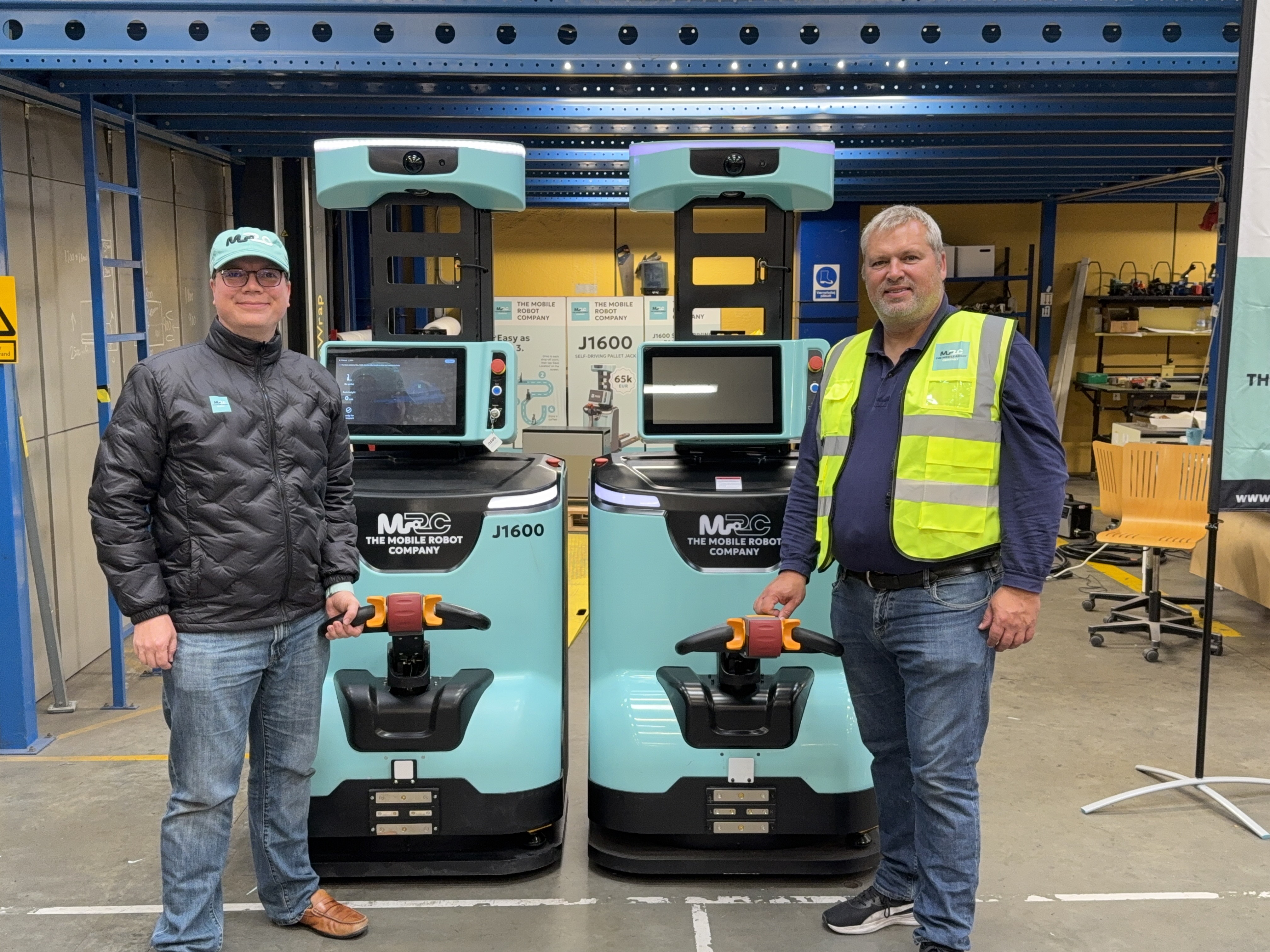
Emil Hauch Jensen & Odin Kudahl Skovsted, founders of The Mobile Robot Company
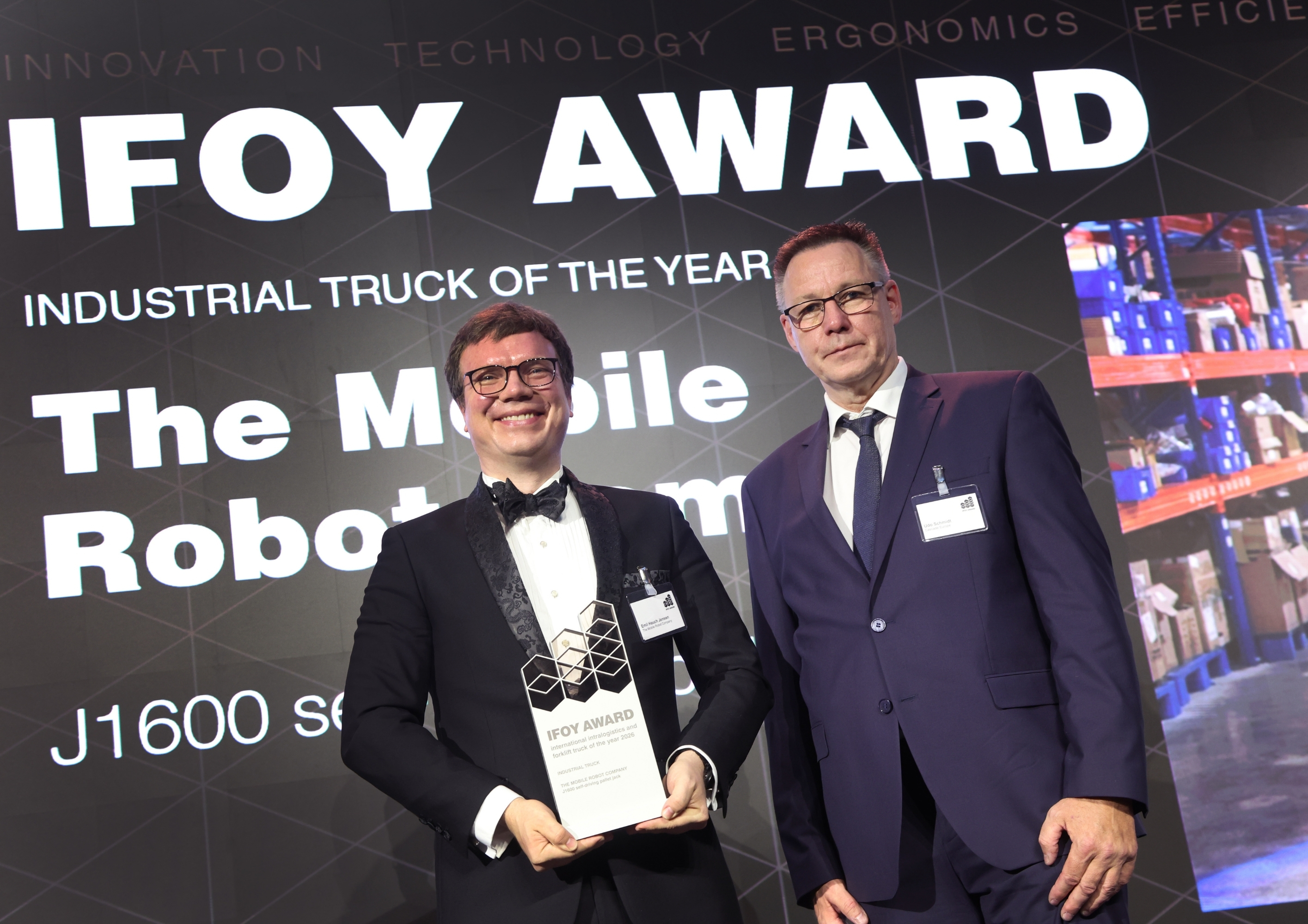
Emil Hauch Jensen, CEO of The Mobile Robot Company, receives the IFOY Award from Udo Schmidt at the IFOY Award ceremony.

J1600 IFOY Industrial Truck of the Year Finalist 2026
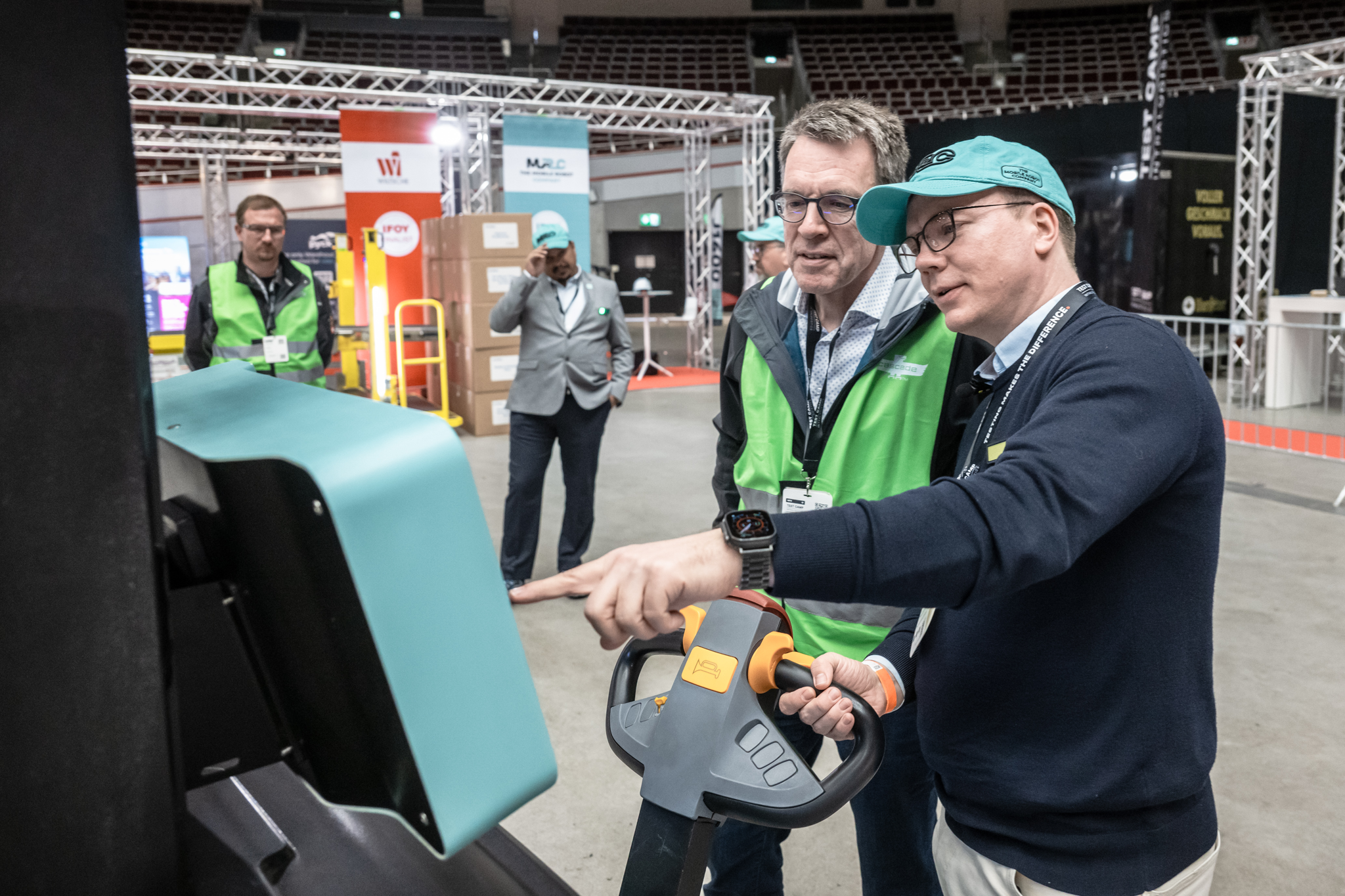
Emil Hauch Jensen, CEO of the Mobile Robot Company is demonstrating the J1600 self-driving pallet jack.
The Mobile Robot Company's J1600 dual-mode pallet jack wins the 2026 IFOY Award, bringing practical, human-in-the-loop automation to global supply chains.
The facility utilized automated conveyor systems and scanning gates, and it possessed some robotic arms that sat idle. But the dynamic, frenetic movement of pallets across the floor was largely handled by human operators driving manual electric pallet jacks. When Jensen asked the operations manager why a company with twenty-four-seven operations and virtually limitless capital expenditure budgets had not fully automated this facility, the answer profoundly shifted his perspective on the future of supply chain robotics.
The manager explained that the facility experienced as many as ten fundamental process changes per week. Driven by constantly evolving customer demands and a shifting mix of stock-keeping units—such as sudden influxes of liquid goods requiring entirely different packaging and handling constraints—the facility’s operations had to be endlessly adaptable. The rigid, pre-programmed infrastructure required for fully autonomous guided vehicles simply could not keep pace with this level of operational volatility. Flexibility, not raw capital, was the ultimate bottleneck.
This realization would eventually serve as the philosophical bedrock for a new venture. Together with his long-time colleague Odin Kudahl Skovsted, Jensen would go on to build a business that deliberately shunned the industry’s obsession with total autonomy. Their startup, The Mobile Robot Company ApS, founded in November 2024 and headquartered in Copenhagen, Denmark, is now challenging established industrial giants by betting that the future of warehouse logistics belongs to humans and machines working in tandem, rather than machines working alone.
THE VETERANS UNITE
To understand the rapid ascent of The Mobile Robot Company, one must look at the deep industry roots of its two co-founders. Between them, Jensen and Skovsted had collectively completed projects for hundreds of customers and overseen the deployment of more than 10,000 robots worldwide.
Jensen’s entry into the automation space began tangentially. While working in industrial sales at Nederman, where he delivered air filtration equipment for welding applications, he witnessed an astonishing technological shift. Within a mere three-year span, the proportion of newly installed welding equipment that was robotized skyrocketed from ten percent to sixty percent. Recognizing the velocity of the robotics market, he soon joined Mobile Industrial Robots (MiR) to run their China business as Vice President of Sales. In China, Jensen was exposed to a scale and speed of business that fundamentally altered his expectations. He witnessed single site project proposals for three thousand to five thousand robots—volumes that European startups could scarcely comprehend.
During his tenure at MiR in 2018, Jensen collaborated daily with Skovsted, who was then serving as the head of the technical support and customer success teams. Skovsted, a senior management executive with over two decades of technological innovation experience, was the critical technical counterpart to Jensen’s commercial operations. Operating out in the Asian region, Jensen relied heavily on Skovsted's technical teams to solve complex, site-specific customer challenges. Their frequent interactions forged a deep professional trust.
Years later, after Jensen had moved on to the Chinese robotics firm Geek+ and subsequently entered a collaboration with Intel, he brought Skovsted over to work alongside him once again. But the true catalyst for their entrepreneurial leap occurred in October 2024 at the ROSCon event in Odense, Denmark. Amidst the hum of the robotics conference, Skovsted turned to Jensen and asked a simple question: why shouldn't they build a robotics company themselves? Jensen was immediately hooked. By November 2024, The Mobile Robot Company was officially born.
THE EIGHTY PERCENT REVOLUTION
The founders shared a contrarian diagnosis of the mobile robotics industry. Having deployed thousands of robots, they knew intimately why so many automation projects failed to deliver on their initial promises. The industry consensus was that robot projects were simply too hard, too slow, and entirely too complex.
The problem, they deduced, lay in the relentless pursuit of one hundred percent automation. Achieving total autonomy required agonizingly complex system integration. Tying together a warehouse management system (WMS), an enterprise resource planning (ERP) system, and a fleet management system to orchestrate every flawless movement of a robot required immense custom engineering. The founders realized that the final five to ten percent of automation was a financial and operational trap.
Their solution was the concept of "human-in-the-loop" automation. Instead of engineering the human out of the warehouse, they decided to build a product that leveraged human judgment for the most complex tasks, while delegating the tedious, non-value-added travel to the machine.
The result of this philosophy is the J1600, a dual-mode self-driving pallet jack. In manual mode, the J1600 operates exactly like a conventional walk-behind electric pallet jack, complete with a familiar tiller. This allows a human operator to handle the judgment-heavy aspects of warehouse work: spotting a broken bottom board on a pallet, assessing a top-heavy or unstable load of liquid barrels, tucking away loose shrink-wrap tails before they snag on a doorframe, or manually navigating a steep dock plate where autonomous gradeability is restricted to zero percent.
Once the operator has safely engaged the pallet, they use a 15-inch multi-touch interface to select a saved destination, press a physical start button to confirm the transition to automatic mode, and step away. The J1600 then navigates the long, repetitive travel segment entirely autonomously. By automating the travel distance, the J1600 removes up to 80 percent of the manual work and operator time spent on repetitive transport. At a transport distance of one hundred meters, the robot operates autonomously for roughly 80 percent of the task duration; at five hundred meters, that efficiency scales to an impressive 95 percent.
HARDWARE REALITIES IN A SOFTWARE AGE
Launching a capital-intensive hardware startup in late 2024 was a bold maneuver. The technology sector was reeling from what Jensen described as a "SaaS apocalypse," driven by the explosion of generative AI capable of writing software code at near-zero marginal cost. Yet, the founders viewed their hardware focus as a formidable defensive moat. The J1600 relies on embedded systems, precision mechanics, and a tightly integrated software stack that cannot simply be generated by a language model.
Developing a CE-marked, safety-certified industrial vehicle in less than a year required ruthless operational efficiency. To achieve this, The Mobile Robot Company partnered with one of the top forklift manufacturers in the world to produce the heavy metal chassis, motors, and welding. This allowed the startup's lean team of just nine employees to focus intensely on the autonomous intelligence and safety architecture.
The technological specifications of the J1600 are robust. Capable of carrying a rated payload of 1,600 kilograms (approximately 3,500 pounds) at a top speed of 5.4 kilometers per hour, the vehicle utilizes advanced 3D LiDAR SLAM (simultaneous localization and mapping) processed by an industrial NVIDIA Jetson AI computer. Unlike legacy Automated Guided Vehicles (AGVs) that require magnetic tape, wires, or QR codes physically installed on the warehouse floor, the J1600 requires absolutely no infrastructure changes. An operator simply drives the vehicle manually through the facility to create a three-dimensional map, scanning structures up to seventy meters away from the vehicle.
Safety is paramount in dynamic industrial environments, and the J1600 features a layered, certified safety architecture. Separate from the 3D navigation LiDAR, the vehicle is equipped with two 2D safety LiDAR scanners that cast a 360-degree protective field around the machine. Crucially, this safety field is speed-dependent, automatically expanding as the vehicle accelerates. The safety functions, including person detection and braking systems, are rated up to Performance Level d (PL d) under the rigorous EN ISO 13849-1 standards.
A HIGH-STAKES DEBUT AND THE IFOY TRIUMPH
The company's timeline was incredibly aggressive. Following market launch on October 20, 2025, and the opening of pre-orders in December, the first products were officially launched in January 2026. But the ultimate proving ground arrived in April 2026 at the TEST CAMP INTRALOGISTICS event in Dortmund, Germany. Here, the J1600 made its first public appearance as a finalist for the prestigious International Intralogistics and Forklift Truck of the Year (IFOY) Award.
The days leading up to the Dortmund test were harrowing. Just forty-eight hours before the vehicle was scheduled to be delivered to the show floor, a critical software bug deep within the safety controller system threatened to derail the entire debut. Working frantically in their Copenhagen lab until six o'clock in the evening, the team loaded the still flawed robot onto a transport truck. Jensen, alongside colleagues Pratheesh and Henrik, drove through the night from Denmark to Germany, unsure if the machine would function. The next morning, a breakthrough communication from their safety controller supplier provided the fix. The team implemented the patch on the show floor during setup, narrowly averting disaster.
The J1600 performed flawlessly throughout the audit. In a testament to its intuitive design, a visiting logistics professional who had only ever operated standard pallet jacks was able to manually drive the J1600, save a new drop location, create an autonomous boomerang return task, and execute the mission in under fifteen minutes.
The scientific IFOY Innovation Check, conducted by prominent research institutions including Fraunhofer IML and Fraunhofer IPA, rated the J1600's functionality as "very good" and declared the vehicle a "game changer" for low-threshold intralogistics automation. This grueling evaluation culminated on June 26, 2026, at a formal ceremony in Stuttgart, where The Mobile Robot Company shocked the industry establishment by winning the IFOY Award for Industrial Truck of the Year, beating out legacy incumbent manufacturers.
THE UNCONVENTIONAL GO-TO-MARKET STRATEGY
Armed with international recognition and the Best in Intralogistics Certificate, The Mobile Robot Company began scaling rapidly. Their commercial strategy is as disruptive as their technology. In an industry notorious for opaque, customized pricing and drawn-out sales cycles, the company publishes its list prices openly. The base J1600 self-driving pallet jack is priced at €65,000. A manual charger adds €3,600, an automatic opportunity-charging station costs €8,400, and a comprehensive installation and commissioning package is offered at a flat €10,000.
A typical fully configured deployment lands around €80,000. When compared to the staggering €1 million price tags often associated with fully integrated, WMS-tethered autonomous fleet systems, the value proposition is highly compelling.
To lower the barrier to entry even further, the company offers a two-week paid trial for just €4,000. This trial includes a full day of on-site deployment, operator training, unlimited remote support, and a no-questions-asked free return policy. Because basic deployment requires absolutely no mandatory Wi-Fi network and no IT integration, a facility can have the robot running productive transport loops on the very same day it is unboxed.
The primary target market is the single-shift small and medium-sized enterprise (SME) operating with one to five manual pallet jacks. These are the forgotten companies of the logistics world—operations that lack the multimillion-euro budgets required for conventional automation but desperately need to mitigate severe labor shortages and reclaim wasted walking time.
Rather than building a massive direct sales force, the company relies entirely on a global network of distributors, integrators, and service partners. This partner-led channel strategy allows them to scale globally with minimal overhead. The partners handle local demonstrations, paid trials, installations, and lucrative after-sales service contracts like the €4,900 per year Basic Care plan or the €13,000 Full Care plan. The Mobile Robot Company provides the hardware, software upgrades, spare parts, and remote technical backing.
This strategy has yielded spectacular growth. Guided by the strategic leadership of Senior Vice President EMEA Fernando Fandiño Oliver, who joined in January 2026, the company successfully established distributor partnerships across eight different countries within nineteen months of its founding. Markets as diverse as Italy—where they partnered with ALCA Technologies to demonstrate the robot's resilience against broken pallets and dusty warehouse floors—and unexpectedly rapid adopters in Vietnam have embraced the dual-mode concept.
SCALING THE SOFTWARE ECOSYSTEM
While the standard software is intentionally stripped down to facilitate configuration-free "teach and repeat" operations, the company built a lucrative upgrade path for enterprise customers. As single-robot deployments inevitably scale into synchronized fleets, customers can purchase an Advanced software upgrade for €14,500.
This premium software tier unlocks a powerful REST API for external system integrations and advanced mission planning. Most critically, it provides full interoperability under the VDA 5050 standard. This standardized interface allows the J1600 to operate seamlessly alongside robots from entirely different manufacturers under a single, unified, third-party fleet management layer. For customers seeking native orchestration, the company also licenses its proprietary Fleet Manager software at €6,500 per robot. Advanced functions, such as the "come-to-me" feature which allows a worker to summon the robot via a mobile application, transform the J1600 into an intelligent, on-demand logistics utility.
LOOKING TO THE FUTURE
Today, The Mobile Robot Company remains entirely owned by its founders. While they are actively engaged in discussions with venture capital firms and angel investors eager to capitalize on their momentum, the company's immediate capital needs are fully covered. Operating with a remarkably lean team of just nine people, they are developing their next unannounced product, hinting at new form factors beyond the pallet jack to serve entirely new market capabilities.
For Emil Hauch Jensen and Odin Kudahl Skovsted, the ultimate endgame is likely a strategic acquisition. However, their broader legacy is already taking shape on factory floors and cross-docking distribution centers worldwide. By challenging the dogmatic pursuit of complete autonomy, they have proven that the most efficient warehouse of the future is not a dark facility devoid of human workers. Instead, it is an environment where technology adapts to people, where machines handle the endless, exhausting distances, and where the human operator remains firmly in the loop, commanding the logistics flow with a simple press of a button.
Emil Hauch Jensen
The Mobile Robot Company ApS
+45 88 10 90 12
email us here
Visit us on social media:
LinkedIn
Instagram
Facebook
YouTube
TikTok
Other
Legal Disclaimer:
EIN Presswire provides this news content "as is" without warranty of any kind. We do not accept any responsibility or liability for the accuracy, content, images, videos, licenses, completeness, legality, or reliability of the information contained in this article. If you have any complaints or copyright issues related to this article, kindly contact the author above.
